



By Marcelo Cabral Filho
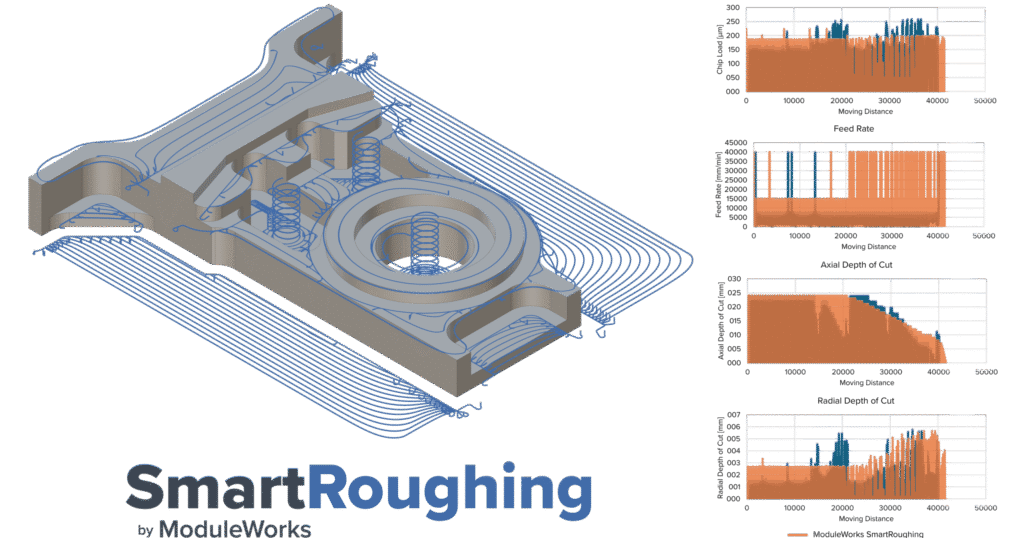
Roughing is often where productivity is won or lost, and every CAM programmer feels that pressure. It is usually the longest phase of a machining cycle, the most demanding on tools and spindles, and the stage where small decisions in feeds, speeds, or stepovers can add hours of machining time or increase tooling costs. When roughing runs well, the rest of the job tends to follow smoothly. When it doesn’t, delays and problems surface quickly, and programmers are often the first to hear about them.
Over the past decade, adaptive roughing has helped machine shops take a major step forward. But today’s production environment is pushing beyond what geometry-only roughing can realistically deliver. Machines are faster, tooling is more specialized, margins are tighter, and experienced CAM programmers are harder to find. Many shops are discovering that adaptive roughing is approaching its practical limits in performance, predictability and consistency.
SmartRoughing is a new approach that helps manufacturers move beyond these limits. By integrating machining physics into the roughing process, SmartRoughing empowers programmers, relieving pressure and giving them confidence to push machines to their full productive potential.
Roughing Decisions Start with the Programmer
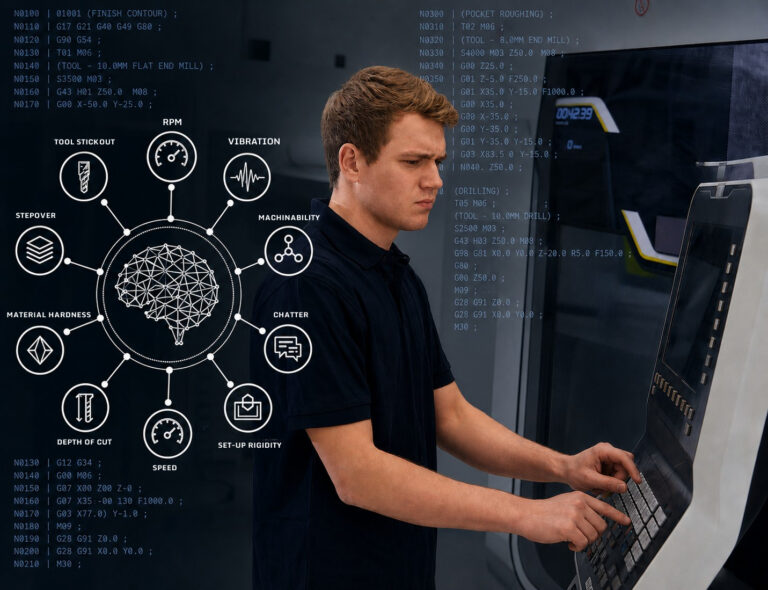
An effective roughing strategy is never just about toolpath shape. Long before the first line of G-code runs, the programmer is weighing a familiar set of questions:
- How much torque and power does this spindle really deliver under load?
- How much stickout can this tool tolerate before chatter becomes a risk?
- Will the material behave consistently or will it punish aggressive engagement?
- Where is the setup least rigid?
In most CAM systems, these considerations still live largely in the programmer’s head. Adaptive roughing smooths engagement but feeds, speeds and depths of cut are typically fixed across the entire job. To stay safe, programmers often choose conservative values based on worst-case conditions.
The result is a strategy that survives everywhere but performs well below the machine’s true capability across large portions of the part. Programmers feel the frustration of knowing a machine could run faster but lack the certainty or time to safely push it.
Why Geometry-Only Roughing Falls Short
Adaptive roughing performs well at responding to part geometry. What it doesn’t understand is why a cut becomes risky or how much faster it could safely run in different regions of the part. That’s because it has no awareness of what is actually happening at the cutting interface:
- How much cutting force is being generated
- Whether the spindle is approaching torque or power limits
- How material behaviour, tool geometry and depth affect load
- Where the process is overly conservative or overstressed
Without this insight, geometry-only roughing comes with unavoidable compromises:
- Parameters set for heavy sections slow down the entire job
- Machine power curves and torque limits remain underused
- Tool life varies unpredictably depending on who programmed the job
- Optimization depends heavily on individual experience
Over time, manufacturing performance becomes dependent on a small number of highly skilled individuals getting the settings right. As shops grow or staff turnover increases, consistency and throughput become increasingly difficult to maintain.
This is where SmartRoughing changes the equation.
From Geometry Awareness to Machining Awareness
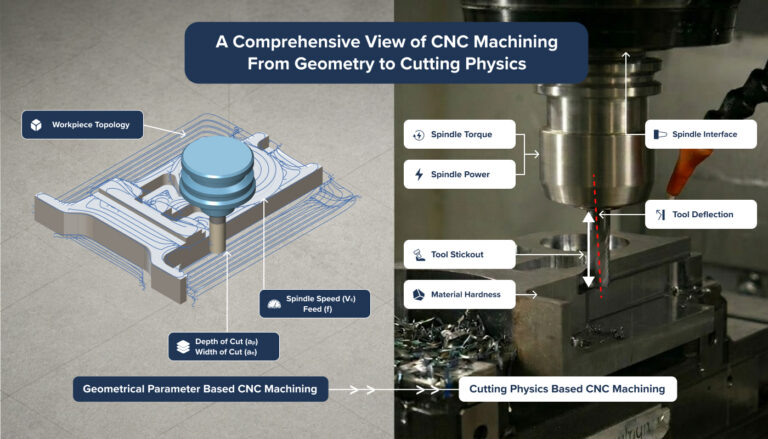
SmartRoughing builds on the strengths of adaptive roughing and extends them with physics-based awareness. When calculating a roughing toolpath, SmartRoughing draws on two integrated resources:
- A physics-based machining engine from Machining Analytics Lab
- Lab-tested cutting coefficients and tooling data from Kennametal
Together, these components allow SmartRoughing to understand how a specific tool–material–machine–spindle combination behaves under load. The system accounts for spindle power and torque curves, feed-drive limits and structural constraints, allowing the roughing strategy to adapt not just to part geometry but to real machining physics.
SmartRoughing applies this through a two-stage optimization process that mirrors how experienced CAM programmers think, but executes it with scientific precision:
- Optimal cutting conditions are determined using predictive force models validated by extensive lab testing.
- Those cutting conditions are applied intelligently to the part geometry, automatically assigning different parameters to different layers through non-uniform depth-step optimization.
The result is a roughing strategy tailored to the actual machining task—cutting harder where it is safe, easing off where required, and staying within machine limits at all times.
What This Means on the Shop Floor
Across multiple parts and materials, SmartRoughing has demonstrated cycle-time reductions of 20–61% compared to ModuleWorks adaptive strategies.
The results below are from machining trials carried out in partnership between ModuleWorks, Kennametal and Autodesk Reseller DSI. The image shows an aluminum part that was machined using ModuleWorks SmartRoughing (left) and ModuleWorks Adaptive Roughing (right).
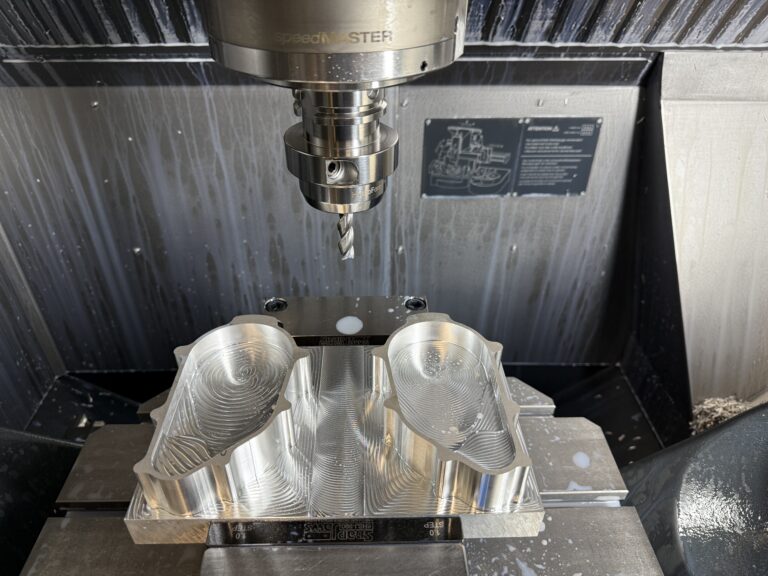
Notice how SmartRoughing uses a bigger stepover in certain localized regions of the toolpath. By automatically adjusting engagement according to pocket depth and machining conditions, SmartRoughing increases the stepover where the machine and tool can safely support it, resulting in faster cycle times.
On this sample part, SmartRoughing reduced machining time by 30 seconds, making it 25% faster than Adaptive Roughing
|
Machining Strategy
|
Machining Time (min, sec)
|
Performance
|
|---|---|---|
|
ModuleWorks SmartRoughing
|
1:30
|
25% Faster
|
|
ModuleWorks Adaptive Roughing
|
2:00
|
Baseline
|
In addition to faster machining, SmartRoughing smooths cutting forces and removes stress peaks that quietly shorten tool and spindle life. In tests, ModuleWorks analyzed the output for machines with different spindle profiles, ranging from 10,000 rpm (low torque) to 15,000 rpm (high torque). Results showed that SmartRoughing successfully protects spindles and tools at the lower end of torque and RPM while still allowing faster cycle times than conventional roughing. As torque increases, SmartRoughing correspondingly increases feed, ae, and ap, all of which see a marked increase in MRR while simultaneously maintaining tool stability.
For CAM programmers, this removes the constant tension between pushing for productivity and protecting expensive equipment. Instead of choosing between speed and security, they can deliver both, making daily production more controlled and predictable.
Helping CAM Programmers Deliver Expert-Level Results
Physics-based roughing doesn’t just optimize toolpaths; it changes how programmers experience the job. It helps newer programmers build confidence, while allowing experienced engineers to focus on productivity rather than repetitive parameter tuning. The result is more consistent output across people, shifts and machines.
Reducing Risk for Novice Programmers
For less-experienced programmers, roughing can be intimidating. Choosing cutting parameters often means balancing limited experience against the real risk of breaking tools or damaging parts.
SmartRoughing removes that pressure. By automatically selecting cutting conditions and maintaining stable engagement, it reduces guesswork and makes results more predictable, allowing newer programmers to learn with confidence instead of worrying about what might go wrong.
Boosting Productivity for Experienced Programmers
As programmers gain experience, the focus shifts to making parts faster, more consistently and with maximum machine utilization, but manual tuning and repeated test cuts still consume time.
SmartRoughing automatically applies optimized cutting conditions, reducing repetitive parameter work. Experienced programmers are free to concentrate on higher-level process improvements, workflow optimization and maintaining consistent results across the shop.
The Shift Towards Physics-Based Manufacturing
SmartRoughing reflects a broader shift away from experience-driven trial and error toward physics-based process planning. By understanding machining behavior before a program reaches the machine, shops can optimize roughing strategies with greater confidence and consistency.
As competitive pressures continue to increase, manufacturers that adopt physics-aware approaches early will be better positioned to control cost, protect equipment, and scale production without relying solely on hard-to-replace expertise.
How to Get Started with SmartRoughing
SmartRoughing is available now as an Autodesk Fusion add-in as well as software libraries in the ModuleWorks software development kit (SDK).
Autodesk Fusion Add-in – FREE Until 31 July 2026
The SmartRoughing add-in for Autodesk Fusion provides direct access to physics-based roughing inside the Fusion environment. The add-in is free to use for a limited time, allowing machine shops to evaluate the benefits of physics-based roughing in their production environment.
Users can download the SmartRoughing add-in directly from the Autodesk App Store: SmartRoughing
Support for the add-in is offered through the familiar Autodesk support channels.
Integration via the ModuleWorks SDK
SmartRoughing is also available as software libraries in the ModuleWorks SDK. This allows solution providers to integrate SmartRoughing directly into their own CAM solutions.
ModuleWorks partners can download the SDK from the customer login section of the ModuleWorks website: https://www.moduleworks.com/
Support is provided by the ModuleWorks support team.
Learning Resources
To help users get started quickly, ModuleWorks provides a set of practical learning resources:
- A short walkthrough video introducing SmartRoughing and demonstrating basic setup
- A longer, in-depth tutorial covering workflow details, parameter behavior and best practices
These resources help CAM programmers understand how physics-based roughing differs from traditional adaptive strategies and how to apply it effectively in day-to-day production.