


KMU-innovativ Collaborative Project: Degradable Molybdenum for Bone Regeneration Using Dental Membranes Produced by Additive Laser Manufacturing (AMoreDentaL) – Subproject: Research into an End-to-End Process Chain for the Additive Manufacturing of Dental Membranes Made of Molybdenum
Funding agency: Federal Ministry of Research, Technology and Space (BMBF)
FKZ: 13X5234C
Details
Motivation:
Molybdenum is a refractory metal with outstanding mechanical properties that, surprisingly, also offers great potential for degradable implants. It combines high strength, good biocompatibility, and uniform degradation. A particularly promising application is customized dental membranes for bone reconstruction in oral and maxillofacial surgery, with a market volume of approximately 136,000 cases and €68 million in annual revenue in Germany.
Objectives and Approach:
The AMore DentaL project aims to process molybdenum into customized, high-strength, biodegradable dental membranes using additive manufacturing (selective laser melting, LPBF). The project partners—FIT AG, ModuleWorks, and Fraunhofer IFAM Dresden—plan to significantly improve the currently inadequate material properties of additively manufactured molybdenum, particularly its low strength and ductility, by optimizing the selection of metal powder, alloying, laser parameters, and post-processing, as well as through simulation-based process planning and optimization. Once the required material properties have been achieved, ReOss will handle the design and additive manufacturing of functional prototypes, which will then be validated in animal models by the Department of Oral and Maxillofacial Surgery in Dresden.
Innovations and Prospects: Innovation in materials and manufacturing lies in improving the properties of additively manufactured molybdenum through experimental and simulation-based strategies. The introduction of customized, high-strength dental membranes could lead to significant therapeutic advances in oral and maxillofacial surgery and other clinical applications in orthopedics or pediatrics. The successful additive manufacturing of molybdenum also offers a cost-effective manufacturing option and a high degree of design freedom not only in medical technology but also, for example, in aerospace and energy technology.
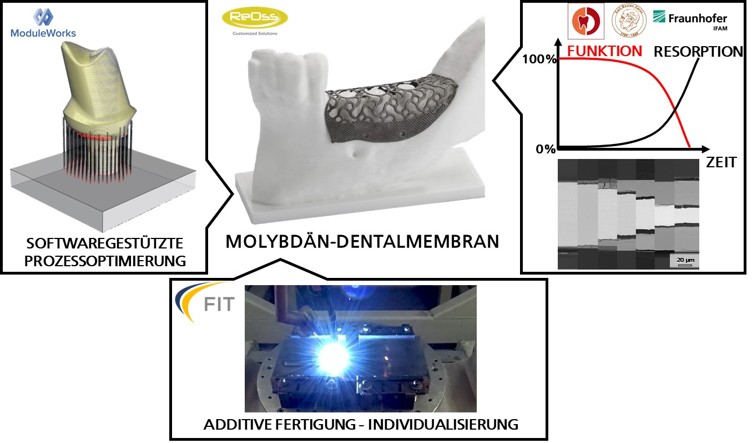
Figure1: Innovations in Project AMore DentaL (Bildquellen: © ReOss, © FIT AG, © ModuleWorks, © Fraunhofer IFAM)
Project Partners
Start: April 2025
End: March 2028